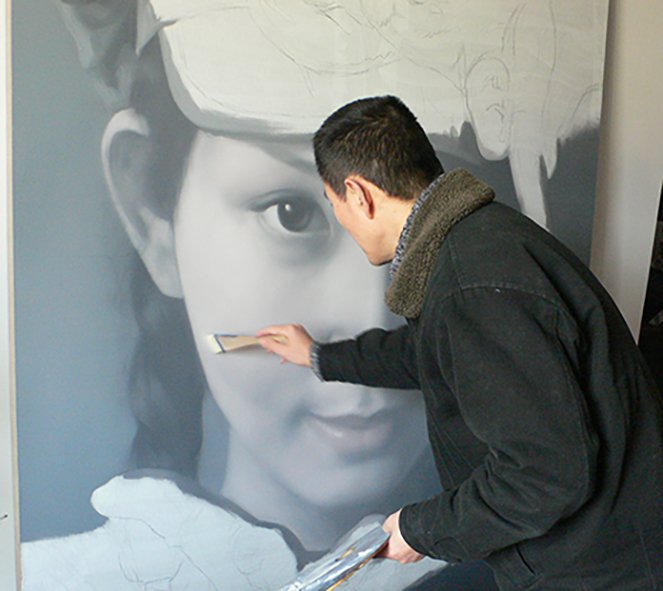
Interpretation of Age Symbols—Interpretation of Zhu Yiyong's Works
When it comes to the development of contemporary Chinese oil painting, it is impossible not to talk about the oil paintings of the post-Cultural Revolution Sichuan School.We cannot talk about Sichuan oil painting without mentioning the scar art and vernacular oil painting that Sichuan oil painting has become famous for. And when talking about the main generals of scar and vernacular art, we can't help but talk about Zhu Yiyong.As one of the main generals of the Sichuan School of Painting, Zhu YiYong and his peers have become familiar figures in and out of the Chinese art circle.
In interpreting Zhu YiYong's recent contemporary oil paintings, it seems that we can start from his early stage of "entering the world", his middle stage of "coming out of the world" and his recent stage of "re-entering the world".During these three phases, Zhu's art has evolved from the sentimental Critical Realism to the academically rich Neo-Classicism, and most recently to the postmodern Post-Symbolism, which has a post-modern orientation, and has been stepping into the contemporary era step by step.
The Sichuan School's "Scar Art" has had an impact on contemporary Chinese oil painting to this day.The reason for this can be said to be the total explosion of social forces accumulated in Chinese society after the Cultural Revolution politics for more than a decade. The painters of the Sichuan School used critical realism as a weapon, and their "Scar Art" was a manifestation of the spirit of the times.With keen social insight, the painters used their brushes to vent the grievances of the people.This passionate "Scar Art" also became the cornerstone of the Sichuan School of Painting, which was the first to make a name for itself in the silent world of painting at that time, and the first to open a new situation.On the one hand, Scar Art reflected on the Cultural Revolution politically, and on the other hand, on the artistic level, it tried to return the original face of art so that it would no longer become a simple microphone for official politics.
As Zhu Yiyong's early "worldly" masterpieces, such as "Little Shop in the Village", his detailed depiction of the village girls' rich earthy atmosphere and sour romantic mood, and his "Father and Son" grandiose scene of dramatic conflict, it seems not difficult to see the artist's sympathy for the lower classes of society and his concern for the human tragedy caused by the Cultural Revolution.and the dramatic conflicts in his "Father and Son", it seems not difficult to see the artist's sympathy for the people in the lower strata of society and his concern for the human tragedy caused by the Cultural Revolution.Early works started from reproducing the storytelling and literary nature of the object, which seemed to be a reasonable choice among Chinese oil painters at that time.The reproduction function of realistic oil paintings aptly helped the artists to establish a communication channel with the public.The artists' eagerness to express and intervene in reality made them choose the realistic painting style, which is quite critical of realism, almost hungrily.In the tide of "Scar Art" that guided the mainstream of art at the time, Zhu YiYong's works demonstrated an artist's concern for reality.The critical realism of the Soviet-Russian Itinerant School of Painting went up in China in the early 1980s, which was inseparable from the "fetishism" of Zhu Yiyong's enthusiastic youths at the Sichuan Fine Arts Institute at that time, and was also closely related to the atmosphere of the times and the level of development of oil painting in China at that time.Art should give vent to people's grievances and play a positive role in the society, and realism with the help of criticism of reality seemed to be the best choice for painters at that time.Intervening in the present world with the realistic style of reproducing the objective present world was Zhu Yiyong's early "entry into the world".
With the opening of the country's gates and the influx of Western modern and contemporary art, the diversification of art began to become a reality in China.Many Sichuan painters continued to make their mark in the "85 New Wave" art movement and the post-modern art movement that followed.However, many artists began to study the uniqueness of oil painting and the national character of oil painting while accepting Western modern art and post-modern art, hoping to free art from the boredom of empty political slogans.Neoclassical, Neo-Academic, Orientalism and other conservative art schools began to go hand in hand with New Wave art.After completing the early stage of his entry into the world with his "scar" and "vernacular" art, Zhu YiYong began to study the language of oil painting, and in the middle of the period, he became obsessed with classical oil paintings and oriental rhythms, and sang three songs in a row, far away from the clamour of the world.During the period of "coming out of the world", Zhu YiYong did not seem to stop thinking about art, but rather, he was struggling with his mind - making a comprehensive study of contemporary art, in order to explore the uniqueness and originality of his own artistic language.In the midst of his apparent retreat, he prepared himself conceptually and linguistically for his subsequent re-entry into the world.
After nearly a decade of exploration, Zhu YiYong's recently launched Red Pentagram series is supposed to be his masterpiece to "enter the world" again.The imperfections of reality are usually the main motivation for artists to create, and the reminiscence of the past is also a common means for artists to utilise the theme to their advantage.Although the sentiment of nostalgia is always present in Zhu Yi Yong's paintings, there is a clear difference between the Red Five Stars series and the earlier "scarred" art, from concept to form.The literary storytelling of the early images has given way to the symbolism and emblematic nature of the images, and the conceptual and metaphorical nature of the images has evolved the traditional composition of the images into post-minimalist neo-realist paintings towards the contemporary era.
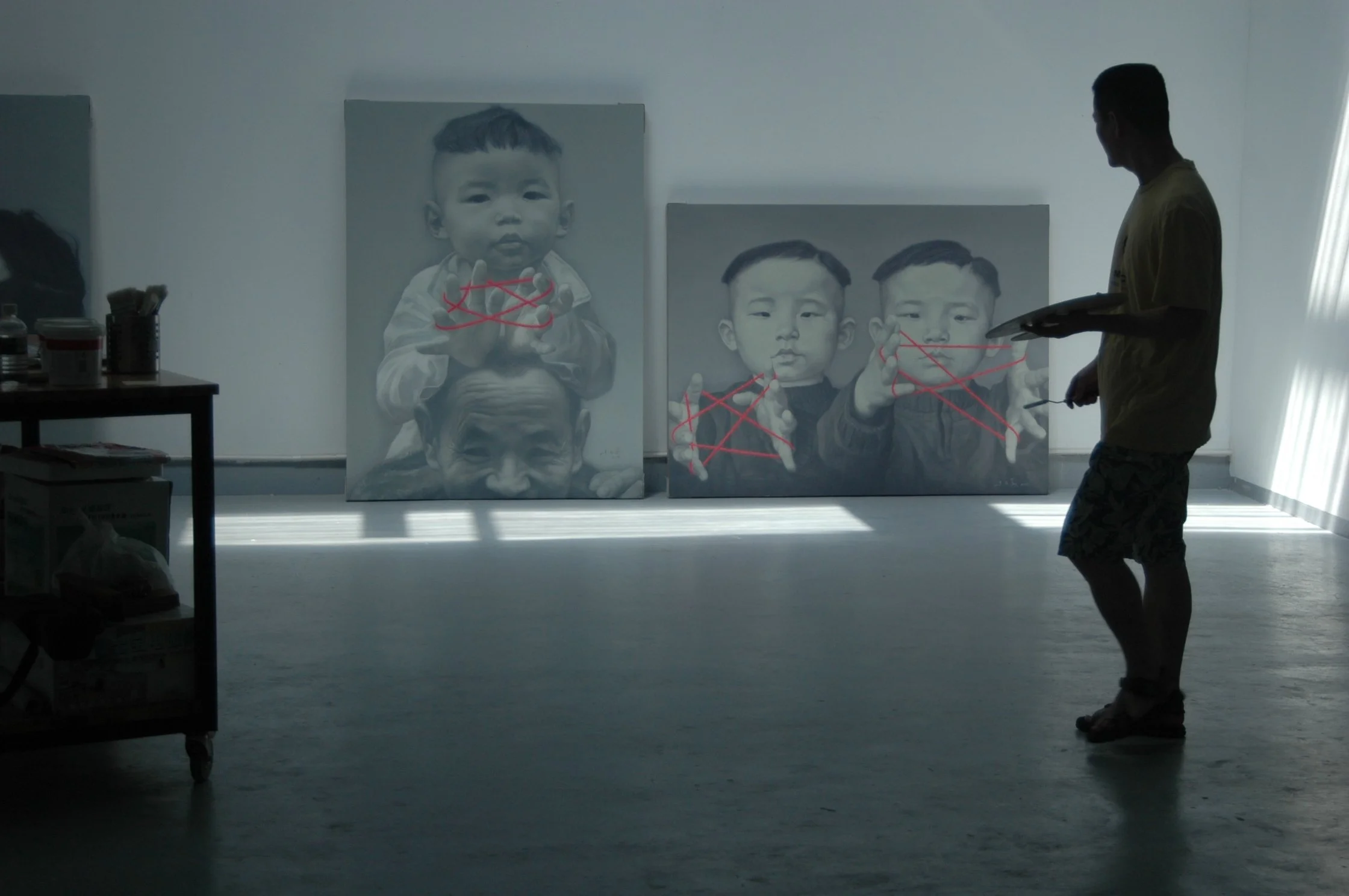
In this new series of red five-pointed star paintings, the artist uses the childhood game of turning over lines as the picture pattern.The red five-pointed star seems to carry more complex connotations than just childhood memories.Especially at a time when material civilisation is developing at a high speed and spiritual civilisation is lagging behind, the red five-pointed star brings people a complex visual experience of sadness and nostalgia, and at the same time, it seems to allow people to reflect on the spiritual alienation brought by the high speed of development of the Du Lian.Zhu YiYong tries to redeem people from the madness of materialistic desire by expressing his remembrance of these remaining symbols, so that the amnesiac public can be liberated from money-worshipping, hedonism, and distorted spirituality, and return to the pristine and innocent era.Although the original symbolism of the red five-pointed star may have been far from what Zhu Yi Yong wanted to express, and the revolutionary feelings of the past that were once illuminated by the red star may have disappeared, the red star evokes memories of the past and should allow us to once again appreciate the innocence of the fragments of memory that remain, aspire to, and build a better end of the ideals and the pursuit of the future.As a symbol of idealism, the red star evokes a complex emotion that Zhu YiYong's new work may be trying to achieve.
Zhu YiYong's pictures are full of his persistent true feelings, and the pictures have a strong visual impact.The characters in the Red Pentagram series come from different social classes.Children, students, adults, the elderly and so on.All of them are monochromatic with the same pattern - the red five-pointed star.The simple colours of the picture only set off a bright red. The treatment of this colour tone naturally highlights the theme, and the empty background reinforces the symbolism and simplicity of the picture.What is interesting is that Zhu YiYong does not simply describe this group of diverse characters, but puts them back in the past and pulls them back to the present.Among them are young women dressed as Red Guards in the old days, as well as the "Stick Army" and the weather-beaten old men who can be seen all over the city of Chongqing nowadays.They are all looking blank as they make the same gesture of turning out the red five-star sign.Obviously, this action, which is hard to see in reality, has a virtual reality in Zhu Yiyong's images.The realism and objectivity of this kind of surreal behaviour itself seems to be meaningless, but the infectious power of the picture itself can make the viewer feel dislocated in time and space in the portrayal of the game action here, and the artist's subjective experience naturally turns into the viewer's objective experience.
From the scars, the vernacular, the oriental charm to the contemporary humanistic care evolution, Zhu YiYong art experience of three stages from the reproduction of the external objective reality to the expression of the artist's subjective spirit, the new nostalgia has a different expression, face to face, face to face with the reality of life, docking the contemporary. The past years are full of bitterness, sadness, beautiful yearning and idealistic innocence.Hopefully, this game of turning over the red five stars can awaken the memory of these fragments of the past, and make a clear thought in this cluttered, noisy and boring moment: should we go back to the past years and retrieve those lost innocence..., or .....?The artist Zhu YiYong seems to be asking the viewer a question.
Gan Yifei in Washington, D.C.
Oct 15, 2006
岁月符号的诠释 ——朱毅勇作品解读
谈到当代中国油画的发展,就不能不谈及后文革的四川画派的油画。谈到四川油画又不能不提及四川油画籍以成名的伤痕艺术和乡土风油画。 而谈及伤痕、乡土艺术的主将时又不能不谈及朱毅勇。作为四川画派主将之一的朱毅勇与他的同辈-画家们在中国艺术圈内圈外都成了人们耳熟能详的人物。
解读朱毅勇近期当代油画,似乎可以从他早期“入世”,中期“出世”近期“再入世”入手。在此三个阶段中朱毅勇的艺术从伤感情调的批判现实主义到学院派意味浓郁的新古典主义直至最近的颇具后现代取向的后象征主义,一步步走进当代。
四川画派的“伤痕艺术”对当代中国油画的影响至今。究其原因可以说是中国社会经历了文革政治近十多年所积蓄的社会力量的总爆发。 四川画派的画家们以批判现实主义作为武器的“伤痕艺术”则是当时时代精神的代言。画家们以敏锐的社会洞察力,用画笔渲泄人民的忧怨。这批激情奔涌的“伤痕艺术”也成为让四川画派在当时沉寂的画坛先声夺人、首开新局的基石。伤痕艺术一方面从政治上反思文革,一方面在艺术层面上力图还其艺术本来的们面目使之不再成为官方政治的简单话筒。
作为朱毅勇早期“入世”的成名作如“山村小店”中对村姑们浓郁的泥土气息和酸楚的浪漫情调的细致描绘,和他“父与子”宏大埸面的戏剧冲突,似不难看出艺术家对社会下层人们的同情和对文革造成的人间悲剧的关注。早期作品是从再现客体的故事性文学性入手,这在当时中国油画家们那里似乎是合符情理的选择。写实油画的再现功能恰入其分地帮助艺术家与大众建立了沟通的渠道。艺术家急于表现和干预现实的热情,使他们近乎饥不择食地选择了颇具批判现实主义的写实画风。在这引导当时艺术主流的“伤痕艺术”大潮中,朱毅勇的作品展示了一个艺术家对现实的关注。苏俄巡回画派的批判现实主义艺术在八十年代初的中国得以滥觞,与当时四川美院朱毅勇诸热血青年们的“拿来主义”分不开,也同当时的时代氛围和中国油画的发展水平密切相关。艺术要渲泄了人们的忧怨,积极地作用于社会,借助批判现实主的写实性似乎是当时画家们的最佳选择。以再现客观现世的写实风格干预现世是朱毅勇早期的“入世”。
随国门的打开,西方现当代艺入的涌入,艺术们多元化开始在中国成为现实。不少的川派画家继续在后来的“八五新潮”艺术运动以及之后的后现代艺术运动中驰咤风云。然而,不少艺术家们在接受西方现代艺术和后现代艺术的同时开始潜心研究油画艺术的独特性以及油画的民族性,希望籍此让艺术摆脱空凡政治口号式的烦燥。新古典、新学院、东方主义等颇具保守意义的艺术流派与新潮艺术开始并驾齐驱。朱毅勇在完成他以“伤痕”、“乡土”艺术入世的早期阶段之后,开始潜心研究油画语言,进入他中期对的古典油画和东方意韵的痴迷,一唱三叹,远离了渲嚣的尘世。在“出世”期间,朱毅勇似乎并没有停止对艺术的思考,而是在苦其心智 -- 对当代艺术作全面地研究,以期探索其自身艺术语言的独特性和原,创性。在表面的急流勇退之中,为后来的再次入世作了观念和艺术语言上的准备。
朱毅勇经过近十年的探索,最近推出的红五角星系列应该是他再次“入世”的力作。现实的不完美通常是激发艺术家创作的主要动因,对过去事物的追忆也是艺术家借题发挥的常用手段。伤感怀旧的情绪虽然在朱毅勇画作中贯注始终,在这批红五星系列则同早期“伤痕”艺术从观念到形式上有着明显的差异。早期画面的文学性故事性巳让位于画面形象的符号性、象征性,画面的观念性、隐喻性己将传统的画面构成演变为颇具后极简主义的新写实主义绘画,走向当代。
从这批红五星系列新作中,画家以童年翻线游戏的方式作为画面图式。红色五角星所承载的除了童年记忆之外,似乎还有更多复杂的内涵。特别是在物质文明高速发展,精神文明相对滞后的当下,红色五角星在带给人们伤感、怀旧等复杂的视觉体验的同时,似乎可以让人们反思杜会高速发展给人们带的精神异化。朱毅勇试图想通过对这些岁月残存的符号的追忆作表述,把人们从物欲横流的疯狂中救赎,让失忆的公众从拜金主义、享乐主义、扭曲的精神中解脱出来,回归那质朴纯真的年代。虽然红色五角星本来的象征意义与朱毅勇想要表达的或许已相去甚远,曾经红星照耀的往日革命情怀或许巳荡然无存,但红星勾起人们对往事回忆应该可以让我们再次体会记忆残存的碎片中有过的纯真,向往、和建设美好末来的理想和追求。作为理想主义的象征物的红五星所勾起的复杂情态或许正是朱毅勇新作想要企及的。
在朱毅勇的画面中充沛着他执着的真情,画面有着很强的视觉冲击力。红五角星系列中的人物主角来自不同社会阶层。少儿、学生、成人、老人等。单色的他/她们都翻出同一个图案—— 红色的五角星。画面单纯的色彩仅为衬出一一个鲜艳的红色。 这一色调的处理自然地突出了主题,加上虚空的背景强化了画面的符号性、单纯性。很有意思的是,通过这批形色各异的人物,朱毅勇没有作简单的描述,而是将人物放回过去又拉回到当代。他们中有往日红卫兵装束的青年女性,又有当下重庆满城都可见的“棒棒军”和饱经风霜的古稀老人。他们神情木然地作着同一个翻出红五星的动作。很显然,这一在当下现实中很难见到的动作,在朱毅勇的画面里有着虚拟的真实。这类超现实的行为本身的真实性和客观性似乎无太大意义,但画面本身具备的感染力却能让观者在这儿时游戏动作的描绘中产生时空错位, 艺术家的主体体验自然而然地变成观众的客体体验。
从伤痕、乡土,东方意韵向当代人文关怀演变, 朱毅勇艺术经历的三个阶段巳从再现外部客观现实转移到表现艺术家主体精神,新的怀旧情绪则有了不同的表述,直面人生、直面现实,对接当代。 过去的岁月充满苦涩、伤感、美好向往、理想主义的纯真。但愿这红五星的翻线游戏能唤醒这些岁月残片的记忆,在这杂乱无绪、喧嚣烦燥的当下理出一丝清晰思绪: 是回归过去的岁月,找回那些失去的单纯…,还是…..?艺术家朱毅勇仿佛在向观者提问。
甘一飞 于华盛顿
2006-10-15