Let memories become a type of symbol ——a critique of Zhu Yi Yong
What makes a drawing what it is, according to its very original purpose, is that it records and represents the surrounding world caught by the human eye. Zhu Yi Yong in his teenage period therefore more often used the drawing pen in his hand to depict that remote and lonely village store in the Sichuan mountains, a place that only just broke away from the era of political fanaticism, one that was full of pain and misery. Now being in mid-age, Zhu's understanding of "drawing" has already gone beyond simply representing and copying the surrounding world, rather it has become a method to recall those immaterial memories that are gradually fading from the human sight.
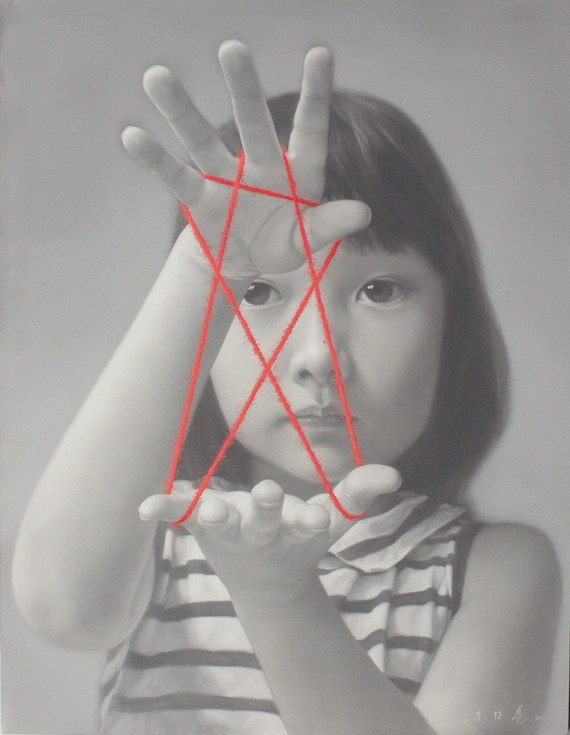
Thus we see in his recent paintings a large number of depictions of young women in old-fashioned army uniforms, as well as portraits of people from different social classes, including children, and they are all demonstrating to the audience the favourite game among youngsters during the Mao era – “turning over the red cord” (i.e. Cat’s cradle). The faces, expressions and temperaments portrayed are all taken from contemporary characters of today, yet they are all showing the red star—the very old and familiar symbol for every Chinese – thus drawing our memories back to three decades ago, to that era flled with fervor and utopian ideals.
The nostalgic red cords contrast sharply with the modern faces on canvases, creating a psychological time-travelling effect for the viewer. The deliberate composition of lighting from the top and from the side creates an outside-to-inside visual depth between the shining of the woolly red cord in the front, the delicate facial expressions of the character in the middle, and the grainy texture of the canvas in the background, which also reinforces the thirty-year time gap between two eras. However, the feverish red era is, after all, the collective memory belonging to a good few generations of Chinese. Those idealistic days are actually not that far away from our reality today, and are still connected to our present through unbreakable and invisible ties. This is the true psychological reaction for every Chinese grown-up, when seeing those very familiar symbols that one used to live with every single day. And even though the portrayed characters have been changed and the settings “modernized” to create distance and an alienation effect, the deepest part in the viewer’s heart ultimately finds familiarity in the depiction, or even fnds it something that had been long engraved in the heart.
Zhu Yi Yong’s masterful Realism painting techniques transform his childhood memories into images that are so extraordinarily vivid, that upon facing such delicate depictions of human details, the memory foodgates inevitably open for every viewer.
From his latest works, we see that Zhu Yi Yong has a new tendency to compose in a more two-dimensional way. He has gradually abandoned the method of using light and perspective to carve out character fgures and background.
Instead of depicting figures with multiple and repetitive strokes, now they are created by multiple layers added up by the paint brush. Also, the boundaries between fgures and their backgrounds are no longer emphasized by deliberate light-and-dark contrasts. The colour-relationships are compressed and reverted back to the primitive black-and-white palette in these latest paintings, and instead of providing viewers with hints and metaphors through light and perspective, Zhu Yi Yong now focuses on adjusting the textures of the flattened form and aims to capture the viewers and speak to them “visually”, instead of through the metaphorical narrative in behind.
This is one important leap. The artist now, consciously or subconsciously, encounters a fundamental problem in two-dimensional paintings: in order to represent mental values and spiritual ideals that cannot be easily expressed by language, and to completely open the viewers’ minds and hence allow them to achieve a higher level of perceptivity and meditation – is the painting supposed to tell a story full of metaphors and hints, or is it supposed to let the form be a visually-textured carrier of symbols?
Zhu Yi Yong’s efforts have allowed him to reach this critical point. His works have shown us that “memories” do not necessarily mean the reappearance of something one remembers from the past, or the depiction of something that one has actually experienced – instead, they could be symbols that are much more complete in spiritual integrity and intellective dimensions.
Gao Ling
Nov 22, 2010
让记忆成为一种象征——朱毅勇画识
绘画之所以成为绘画,首先就其最初的功能来说,是记录和再现人的肉眼所捕捉到的周围世界。于是,青年时期的朱毅勇更多的是用自己手中的画笔,刻画下那个刚刚摆脱了狂热政治运动后巴山蜀地偏远、寂静的山乡的一家小店,其中充满了伤感和苦楚。如今,步入中年的他,对于绘画的理解早已超越了再现和描摹周围世界的阶段,而是将绘画作为追忆那些逐渐从人们的视线中消失的非物质记忆的一种方式。
如此,我们看到他近年来大量创作的身穿旧式军装的青年女性形象,也看到包括儿童在内的其他社会各阶层的人物肖像,他(她)们无一例外地都面向观众做着毛泽东时代青少年常玩的翻红绳游戏。这些表情、气质和长相都取自我们当下时代的人物,却在翻弄和展示着每一个中国人耳熟能详的红五角星,从而将人们的记忆拉回到三十年前那段充满激情和乌托邦理想的时代。人物形象气质的当代感和红绳游戏的怀旧感之间的差异,形成了观众时光荏苒、光阴穿梭的心理变幻效果。顶光和侧逆光的刻意营造,使前景红绳毛绒绒的亮光、中景人物面部逆光中细微的表情描绘和背景的画布颗粒质地之间,呈现出一种视觉上由表及里的纵深感,同样强化了两个相差三十年以上的时代彼此之间的距离。然而,那个火红年代的一切毕竟是整整几代中国人的集体记忆,那个理想化的时代毕竟离今天我们的现实生活并不遥远,它与我们的今天当代依然有着难以割舍和无法看见的关联,这才是成年的中国人每当看到那些曾经终日生活其中的图像时的真实心理反应,尽管它被换以今天的人物和场景出现,具有了陌生化的心理间隔效果,但终究在观众的心理底层它是熟悉的,甚至是刻骨铭心的。
朱毅勇高超的写实绘画手法,让自己的童年记忆幻化为这些逼真到呼之欲出的形象之中,而作为观众的我们则也在这些细致入微的人物肤色的描绘中,打开了记忆的闸门。
从新近的作品看,朱毅勇的画作出现了平面化的倾向,用光和透视来勾勒和廓定人物姿态和画面背景的手法逐渐被取消,形象的刻画不再是被反复描绘出来,而是被画笔几层几遍地涂绘出来,其与环境背景的边界关系也不再刻意是通过明暗关系的层层描绘来达到。一批色彩关系被压缩和还原到黑白灰简单色调的新作,就这样跃然于我们的眼帘。艺术家开始拒绝向观众更多提供画面中通过光源和透视而产生的心理提示和隐喻,而是转而调动画面被平面化的形象本身的块面感和质地感,试图让画面形象本身的视觉性而不是隐喻的叙事性来说话,来抓住观众的视觉眼睛。
这是一次重要的跨越,艺术家开始有意无意地触碰到平面绘画的一个基本问题,即绘画是要向观众讲述一个充满隐喻和暗示的故事,还是要让形象作为一个具有视觉质感的符号载体,去象征某种难以用文字语言表达的思想观念和精神意图,去彻底打开观众的思维路径,获得更大的心理感知力和冥想面。朱毅勇的努力,使他站在了这样一个临界点上,他的作品让我们相信记忆不仅必然是一种回忆的复现和曾经经历的描绘,而且可能是一种更加具有精神内涵和思维维度的象征。
高 岭
2010-11-22